
informational 5 min read
Moon Phase and Atacama Stargazing
Updated September 22, 2026
Google’s own AI Overview for Atacama stargazing tells you to avoid the full moon. It does not tell you when the full moon is for your dates, and neither does any page currently ranking for it. That is the gap this page fills.
Why it matters more than anything else
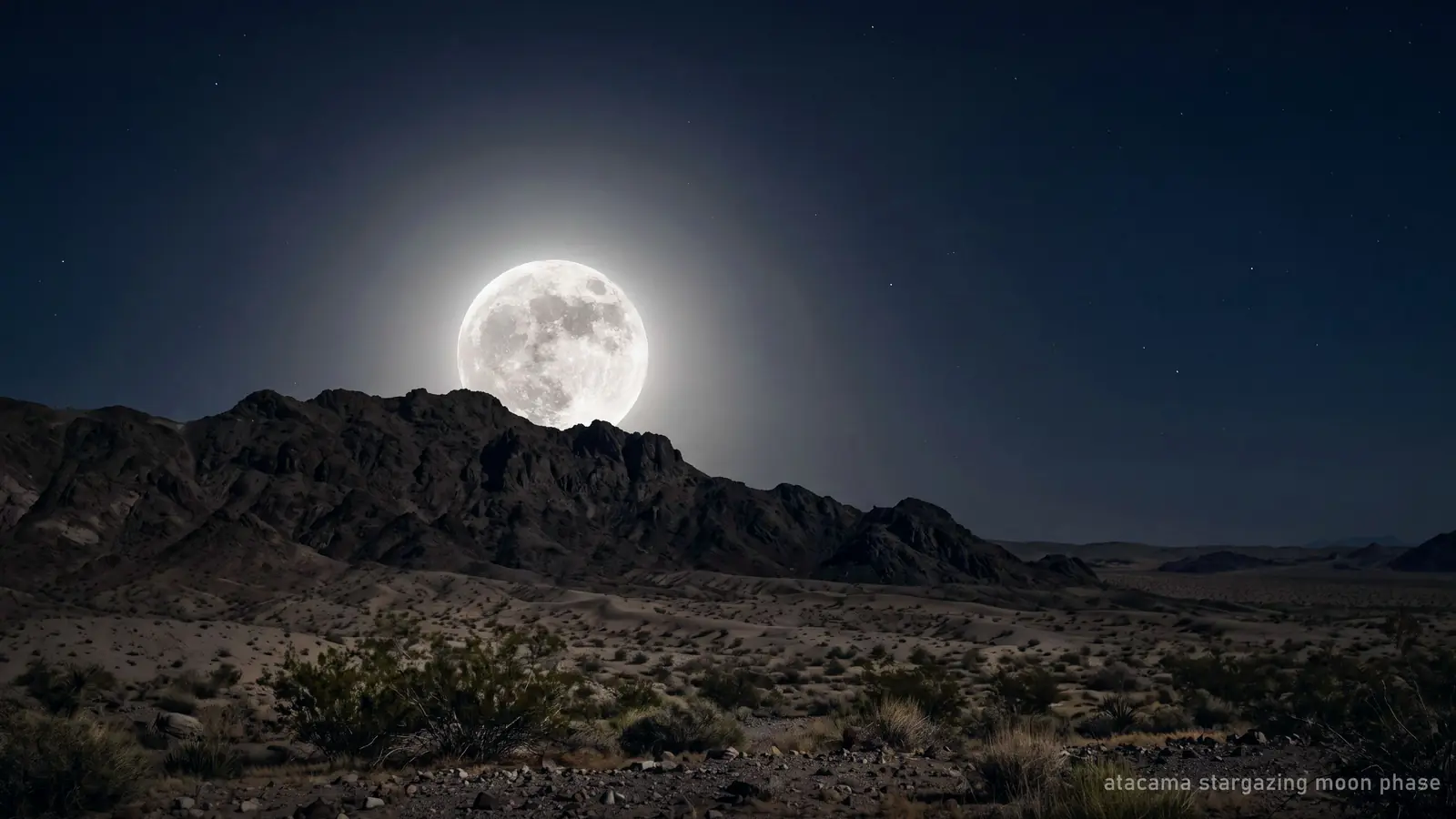
A full moon is roughly a hundred thousand times brighter than the night sky without it. It floods the atmosphere with scattered light, and the effect on faint objects is the same as a city’s light pollution — except that you have flown to the driest, darkest, highest place on Earth specifically to escape that.
Under a full moon you lose the Milky Way almost entirely. You lose the Magellanic Clouds. Nebulae go. What survives is the moon itself, the planets, the bright double stars and the star clusters.
The telescope does not help. Aperture gathers more of the sky glow along with more of the object.
What the operators will not say
Tours run every night. The listing does not mention the moon. Nobody will ring you to suggest a different date, and the guide will make the best of whatever sky there is — which, in fairness, they are good at.
The decision is yours and you have to make it before you book.
New and full moons, San Pedro de Atacama
Times are Chilean local, accounting for the summer-time change. Aim for a date within about four days either side of a new moon; avoid the three days either side of a full one.
| New moon | Full moon |
|---|---|
| 10 Oct 2026, 12:51 | 26 Oct 2026, 01:12 |
| 9 Nov 2026, 04:03 | 24 Nov 2026, 11:54 |
| 8 Dec 2026, 21:53 | 23 Dec 2026, 22:29 |
| 7 Jan 2027, 17:25 | 22 Jan 2027, 09:18 |
| 6 Feb 2027, 12:57 | 20 Feb 2027, 20:24 |
| 8 Mar 2027, 06:30 | 22 Mar 2027, 07:44 |
| 6 Apr 2027, 19:52 | 20 Apr 2027, 18:28 |
| 6 May 2027, 06:59 | 20 May 2027, 07:00 |
| 4 Jun 2027, 15:41 | 18 Jun 2027, 20:45 |
| 3 Jul 2027, 23:03 | 18 Jul 2027, 11:46 |
| 2 Aug 2027, 06:06 | 17 Aug 2027, 03:29 |
| 31 Aug 2027, 13:42 | 15 Sep 2027, 20:04 |
| 29 Sep 2027, 23:37 | 15 Oct 2027, 10:48 |
| 29 Oct 2027, 10:37 | 14 Nov 2027, 00:27 |
| 28 Nov 2027, 00:25 | 13 Dec 2027, 13:10 |
| 27 Dec 2027, 17:13 | 12 Jan 2028, 01:04 |
| 26 Jan 2028, 12:13 | 10 Feb 2028, 12:04 |
| 25 Feb 2028, 07:38 | 10 Mar 2028, 22:07 |
| 26 Mar 2028, 01:32 | — |
These are computed from the standard astronomical algorithm rather than copied from anywhere. As a check on the arithmetic: the new moons of 6 February 2027 and 2 August 2027 are both solar eclipses — the annular one and the long total one — and solar eclipses only happen at new moon. The dates land exactly where they should.
If your dates are fixed
You may simply have a full moon. It is not a disaster and it is not a reason to skip the tour.
A moonlit desert is its own thing, and the guide will show you the moon’s own terminator through a telescope, which is genuinely spectacular and which you cannot see at all when it is new. Saturn’s rings and Jupiter’s moons are unaffected. The Southern Cross and Alpha Centauri are bright enough to hold up.
What you should do is adjust the expectation rather than the booking: you are going to look at objects, not at the galaxy.
If your dates are flexible
Put the stargazing on the darkest night of your stay and build the rest of the week around it. It is a two-and-a-half hour evening tour, so it costs you no daylight and can sit on any day.
Then book that night, and read what you will actually see before you go.
Check prices & dates
Book your tickets in advance: popular time slots sell out.
Compare Atacama Tours