
informational Pillar guide 8 min read
Stargazing in the Atacama Desert
Updated September 22, 2026
Astronomers did not choose this desert by accident. Three conditions have to coincide for a sky to be exceptional — altitude, dryness and darkness — and almost nowhere on Earth has all three the way the Atacama does. San Pedro de Atacama sits at 2,407 m with the excursions climbing well above 4,000 m, the air holds almost no water vapour, and the nearest city of any size is 100 km away behind a mountain range.
The result is that a large share of the world’s major ground-based telescopes are within a few hundred kilometres of the town, and that the ordinary commercial tour leaving town at nine in the evening is showing you the same sky.
What the numbers actually say
The station record for San Pedro gives relative humidity between 13 and 38 per cent through the year, with the driest months — August, September and October — sitting at 13 and 14 per cent. Rainfall across the whole year is 38 mm, and seven months of the twelve record 1 mm or less.
Water vapour is what blurs and dims starlight. Those numbers are the reason the sky here is different, and they are measured rather than asserted.
What a stargazing tour is
Two hours or so, out of town to a site dark enough that the horizon glow from San Pedro does not matter. A guide takes you through the naked-eye sky first — and that part is genuinely the better half, because the southern sky is unfamiliar if you have only ever looked up from the northern hemisphere.
Then the telescopes. What they are pointed at depends on the season and the night, which is why no honest listing publishes a target list in advance.
Blankets and a hot drink are standard, and they are not a nicety. You are standing still outdoors after dark at 2,400 m, and in winter that means below freezing.
The southern sky
This is the part people do not anticipate. From the Atacama you see:
- The Magellanic Clouds, two satellite galaxies of the Milky Way, visible to the naked eye as faint smudges and invisible from Europe or most of North America.
- The Southern Cross and the Coalsack, a dark nebula silhouetted against the Milky Way.
- Alpha Centauri, the nearest star system to our own, which never rises above the horizon north of about 29 degrees.
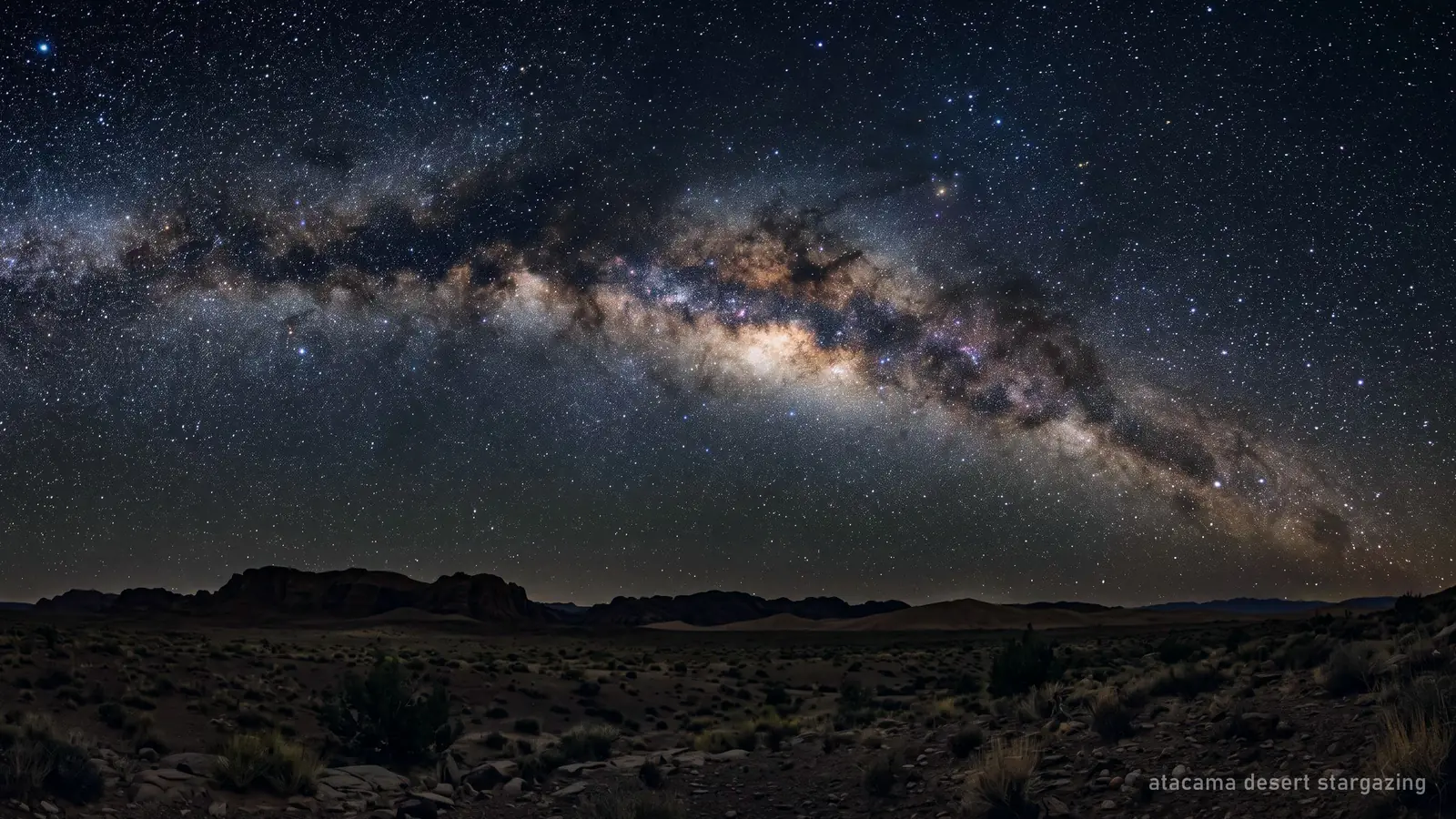
- The galactic core passing close to overhead rather than scraping along the southern horizon, which is what makes the Milky Way here look like a structure rather than a haze.
The one thing that decides your night
The moon. A full moon washes out the Milky Way and everything faint, and no telescope and no guide can compensate for it.
Tours run every night regardless, and the operator will not tell you that your date is a poor one. If your travel dates are flexible at all, book within a few days of a new moon. We publish the new and full moons for the next eighteen months in Chilean local time so you can check yours.
Which months are clearest
Every month is good. The dry winter — June, July and August — is usually described as the best, and the humidity figures support it at 20, 18 and 14 per cent.
The trade-off is temperature. July nights in San Pedro average −0.8 °C and the desert sites the tours use are colder. September and October give you the same very low humidity, 13 per cent, with night-time lows around 3 and 4 °C instead. That is the quiet recommendation on this page: September and October give you winter’s sky at autumn’s temperature.
The exception to avoid is February, the altiplanic winter, when the region takes 21 mm of its annual 38 mm of rain and cloud over the Andes is at its most likely.
The professional observatories
ALMA, the Atacama Large Millimeter/submillimeter Array, runs limited public visits at weekends by advance reservation, and it is a scientific facility rather than an attraction — the visit is to the support base, not to the array at 5,000 m. Paranal and the other major installations have their own, similarly restricted, arrangements.
None of them is a substitute for a stargazing tour, and none of them is bookable through this site. If the science is what draws you, plan it separately and book it directly, months ahead.
What to bring
More clothing than the afternoon suggests. A red torch if you have one, because white light destroys your night vision and everyone else’s. And no expectations about phone photography: the astrophotography included on most tours exists precisely because a phone cannot do this.
Then book the night, ideally one without a moon in it.
Check prices & dates
Book your tickets in advance: popular time slots sell out.
Compare Atacama Tours