
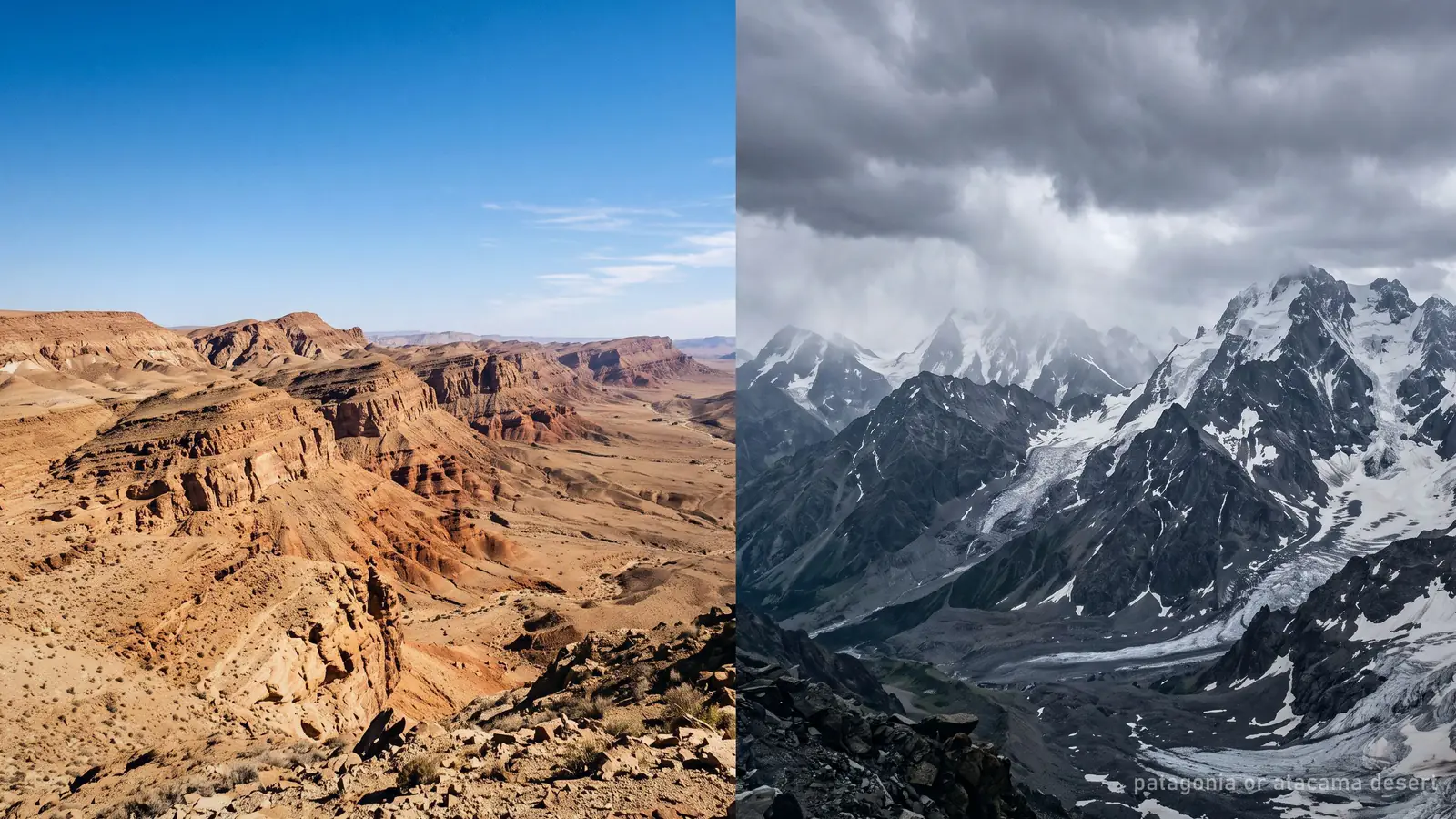
Atacama or Patagonia: Which Chilean Trip
Verdict
If you have under a week, go to the Atacama — Patagonia cannot be done properly in five days and the Atacama can. If you have two weeks, do both, and let the season decide the order: Patagonia in the southern summer and the Atacama in the shoulder months either side of it.
This comparison appears in Google's People Also Ask on almost every Atacama search we ran, which tells you it is the decision people are actually making. The two are at opposite ends of a country 4,300 km long and they have essentially nothing in common except the flag. They also peak in opposite seasons, which is the fact that usually settles it.
| Criterion | The Atacama Desert | Patagonia |
|---|---|---|
| What you go for | Landscape and the night sky; almost no walking required | Mountains, glaciers and ice; walking is the point |
| Best season | April–May and September–October; driest and mildest | November–March; the southern summer |
| Fitness needed | Low, but altitude to 4,320 m | Moderate to high; multi-day treks at sea level |
| Time needed | Three to five days | Seven to ten days minimum |
| Weather risk | Very low outside February | High; Patagonian weather changes hourly |
| Getting there | Fly to Calama, then 100 km by road | Fly to Punta Arenas or Balmaceda, then several hours by road |
| Cost per day | High for excursions, moderate otherwise | High throughout; park fees and remote logistics |
They peak in opposite seasons
Patagonia is a November-to-March destination; outside that window the weather closes in, the days shorten and much of it is inaccessible. The Atacama is best in April–May and September–October, and is at its worst in February — which is the heart of Patagonia's season. On a two-week trip that inversion is a gift, because one of them is always in a good window.
The physical demand is different in kind
Patagonia asks for walking, often for days, in weather that changes hourly, but it does it at sea level. The Atacama asks almost no walking, but puts you at 4,320 m before breakfast. Neither is harder; they are hard in ways that suit different people, and altitude in particular is not something you can train around.
Time is the real constraint
Torres del Paine alone is three to five days of walking plus two days of travel at either end. The Atacama is properly seen in three to five days total. If your trip is a week, the Atacama fits and Patagonia does not, and attempting Patagonia in five days is how people end up with two travel days and one view.
The case for the Atacama, put plainly
It is compact, the weather is essentially reliable, and it holds one thing that Patagonia does not have at all: the clearest night sky on the planet. If the Milky Way overhead is on your list, there is no version of Patagonia that substitutes.
The case for Patagonia
Scale, and the fact that you move through it rather than looking at it from a van. If what you want from a trip is to have walked somewhere, the Atacama will not satisfy you, however good the photographs are.
Frequently asked questions
Can you do both in one trip?
Yes, and the seasons help: Patagonia in the southern summer, the Atacama in the shoulder months either side. Allow two weeks, and budget a day for the internal flights.
Which is better for a first trip to Chile?
The Atacama if you have under a week, Patagonia if you have ten days and want to walk. They are not substitutes for one another.
Which is more expensive?
Patagonia over a whole trip, because it takes longer and the logistics are remote. Per day, the Atacama's excursions are the bigger single cost.